Rohtas Fort, a day from Islamabad
A sixteenth-century fortress in the Salt Range, within easy reach of Islamabad, offers a day of history and landscape.
 Photo: Zyn Aly / Pexels
Rohtas Fort stands on a plateau above the Kahan River in Punjab, about a two-hour drive from Islamabad. Built in the 1540s by Sher Shah Suri, the fort was never taken by force. Its massive walls, gates and bastions are a UNESCO World Heritage Site and make a rewarding day out from the capital.
Getting there from Islamabad
The fort lies near the town of Dina, off the Grand Trunk Road, roughly 120 kilometres south of Islamabad. The drive takes about two hours via the M-2 motorway and then the GT Road. From Rawalpindi, the distance is similar. A car with a driver is the simplest option, as public transport involves changing buses at Dina or Jhelum.
The route passes through the Salt Range, a low line of hills between the Punjab plains and the Potohar plateau. The landscape is dry and rocky, with scattered acacia trees. The final approach to the fort is via a narrow road that climbs to the main gate. The fort is signposted from the GT Road.
There is no railway station at the fort. The nearest railway access is at Jhelum, from where a taxi can be hired. The drive from Jhelum takes about 45 minutes. The fort is open daily from morning to evening. A fee is charged for entry. Visitors should carry water and sun protection, as shade is limited.
The walls and gates
The fort's most striking feature is its circuit of walls, which run for about four kilometres around the plateau. The walls are built from large blocks of stone, with battlements and loopholes. They follow the natural contours of the land, rising and falling with the rock. The height varies, but in places the walls stand over 10 metres tall.
There are twelve gates in the circuit, each with a different name and design. The Sohail Gate is the main entrance and the most elaborate, with decorative stonework and a curved passage. Other gates include the Shah Chandwali Gate, named after a saint, and the Kabuli Gate, which faces west. Some gates are better preserved than others.
Walking the full circuit takes a few hours. The walls offer views over the surrounding countryside, including the Kahan River and the distant hills. The fort is largely ruined, but the scale of the defences is clear. Visitors can climb parts of the walls, but care is needed as there are no guard rails in places.
قلعہ روہتاسQila Rohtas, the fort's name in Urdu, meaning the fort of Rohtas.
Inside the fort
Within the walls, the fort contains a number of buildings and structures. The most prominent is the Man Singh Palace, a large complex with a courtyard and rooms. It was built later, during the Mughal period, and shows Rajput and Mughal architectural influences. The palace is partly restored and gives a sense of the fort's later use.
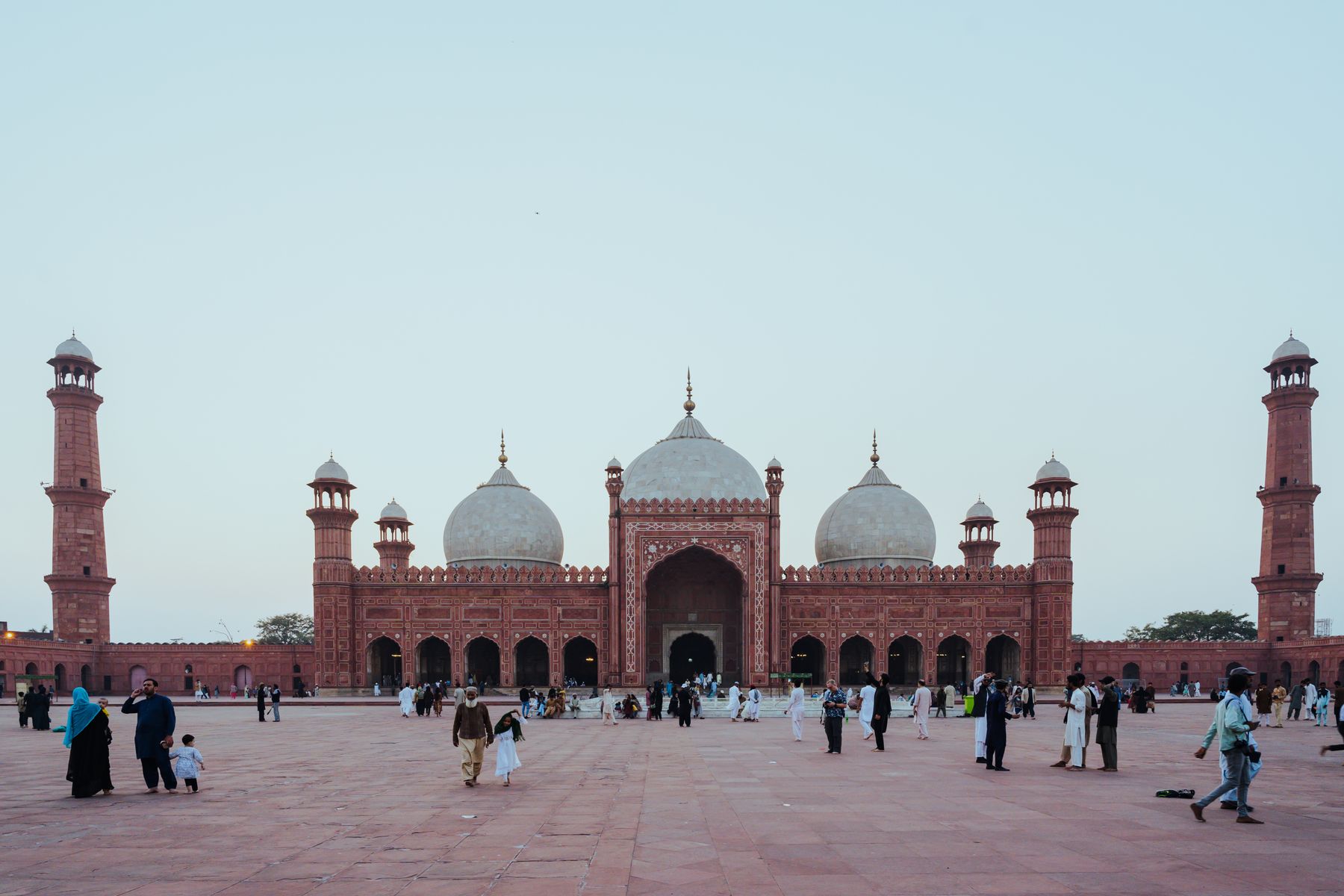
Another notable building is the Shahi Mosque, a small mosque with three domes. It stands near the Sohail Gate and is still in use. The mosque's simple design contrasts with the military architecture around it. Nearby, there is a stepwell, or baoli, which once supplied water to the garrison. It is deep and partly overgrown.
The fort also contains the tomb of Khair un-Nissa, a small domed structure. The identity of the person buried there is not certain. The tomb is modest but well preserved. The rest of the interior is open ground, with scattered ruins and some cultivated fields. There are no shops or restaurants inside the fort, so visitors should bring food and drink.
History and significance
Sher Shah Suri built Rohtas Fort after defeating the Mughal emperor Humayun in 1540. The fort was designed to block the route between Kabul and the Punjab and to subdue the local Gakhar tribe. The name Rohtas comes from the fort of Rohtas in Bihar, which Sher Shah also held. The fort was never completed in his lifetime.
After Sher Shah's death, the fort was taken by the Mughals. It was used as a garrison and later as a residence for Man Singh, a Mughal general. The fort fell into disrepair after the Mughal decline. It was restored in the twentieth century and became a UNESCO World Heritage Site in 1997. The fort is now protected by the government.
The fort is an example of early Mughal military architecture, with influences from Afghan and Indian styles. Its walls and gates are among the best preserved of their kind in Pakistan. The site is also important for its association with Sher Shah Suri, who introduced the rupiya currency and the Grand Trunk Road. The fort is a popular day trip from Islamabad and Rawalpindi.
What to eat and nearby
There are no food stalls inside the fort, but the nearby town of Dina has basic restaurants serving Punjabi food. A typical meal might include daal, roti and chicken karahi. In Rawalpindi, the fort is often combined with a visit to the Raja Bazaar or the old city, where street food such as samosas and jalebi is available. The fort itself is a picnic spot for families.
The area around Rohtas is agricultural, with wheat and maize fields. The Kahan River flows below the fort, and there are small streams in the surrounding hills. The nearby village of Rohtas has a few shops. The fort is also close to the Salt Range, which has several other historical sites, including the Katas Raj temples, a complex of Hindu temples around a pond.
Katas Raj is about 30 kilometres from Rohtas and can be visited on the same day. The temples are set in a small valley and date from the sixth century. The site is sacred to Hindus and has a peaceful atmosphere. The drive between the two sites takes about an hour on narrow roads. Visitors should check local advice before travelling in the area.
Where to find it
- DinaA town on the GT Road, about 8 km from the fort. It has basic restaurants and shops.
- JhelumA city on the GT Road with railway access and hotels, about 45 minutes from the fort.
- Katas RajA complex of Hindu temples around a pond, about 30 km from Rohtas, worth a detour.
- RawalpindiA base for visiting the fort, with hotels and transport options, about 120 km away.
Frequently asked questions
How far is Rohtas Fort from Islamabad?
Rohtas Fort is about 120 kilometres from Islamabad, a drive of roughly two hours via the M-2 motorway and the GT Road. From Rawalpindi, the distance is similar. The final approach is via a narrow road that climbs to the fort.
What is the best time to visit Rohtas Fort?
The cooler months from October to March are the most comfortable, with mild days and cold nights. Summers are very hot, with temperatures often above 40°C. The fort has little shade, so an early start is advisable.
Are there facilities at Rohtas Fort?
There are no shops or restaurants inside the fort. Visitors should bring water and food. Basic restaurants can be found in Dina, about 8 kilometres away. A fee is charged for entry, and the fort is open daily from morning to evening.
Find a stay in Rawalpindi
Live prices and availability open in the IMPT app, in a new tab.